A transfer stretcher (also called a patient stretcher, hospital stretcher, or transfer bed) is a mobile bed designed to safely move patients between hospital departments or between facilities. It combines features of a hospital bed (adjustable height, side rails, IV pole mounts) with the mobility of a wheeled cart.
Transfer stretchers serve 5 primary clinical workflows: intra-hospital transport, emergency resuscitation, ambulance transport, OR-to-recovery transport, and imaging-guided procedures.
|
Feature |
Transfer Stretcher |
Hospital Bed |
|
Primary purpose |
Mobile transport |
Stationary patient care |
|
Mobility |
High (4 large casters, central brake) |
Low (small casters, semi-mobile) |
|
Typical stay |
Minutes to hours |
Days to weeks |
|
Adjustment speed |
5-15 seconds |
15-30 seconds |
|
Patient comfort |
Medium |
High |
|
Imaging compatibility |
Optional (carbon fiber board) |
No |
|
X-ray transparent top |
Premium models only |
Never |
|
Footprint |
Compact (1930 x 640mm) |
Larger (2200 x 1000mm) |
|
Price range (USD) |
$1,200 - $4,000 |
$250 - $5,000 |
The fundamental difference: transfer stretchers are designed for safe, efficient transport, while hospital beds are designed for patient comfort over multi-day stays.
7 Types of Transfer Stretchers
Type 1: Basic Hydraulic Stretchers
Use cases: Ward-to-ward transport, ED to observation, basic hospital logistics
Key features:
Hydraulic foot-pedal height adjustment
Manual backrest (crank or ratchet)
Central locking casters
Foldable side rails
200-220 kg load capacity
Price range: USD 1,200 - USD 1,800
ICARE models: CA-800 (USD 1,200+), CA-801 (USD 1,600+)
Best for: Small hospitals, budget-conscious facilities, basic transport needs
Type 2: Advanced Hydraulic Stretchers
Use cases: OR to recovery, ICU to imaging, complex intra-hospital transport
Key features:
Full hydraulic height adjustment (foot pedal)
Adjustable backrest (pneumatic or hydraulic)
Trendelenburg positioning
Central locking + directional lock
IV pole, oxygen tank holder
230-250 kg load capacity
Price range: USD 2,000 - USD 2,800
ICARE models: CA-802 A/B (USD 2,200-2,600)
Best for: Mid-size hospitals, surgical departments, ICU workflows
Type 3: Ambulance Stretchers
Use cases: Pre-hospital transport, EMS, inter-facility patient transfer
Key features:
Vehicle mounting system (locking to ambulance floor)
Compact folding design (fits ambulance interior)
Restraint belts (3-point or 5-point)
Telescoping handle for loading
200-250 kg load capacity
Battery-powered loading option (premium)
Price range: USD 2,500 - USD 3,800
ICARE model: CA-807 Medical Transport Vehicle (USD 3,500+)
Best for: EMS services, ambulance operators, hospital ambulance bays
Type 4: OR Transfer Stretchers
Use cases: OR to recovery, surgical patient transport, anesthesia workflow
Key features:
Hydraulic height matching OR table height
Full radiolucent top (for imaging procedures)
Anesthesia-friendly materials (anti-static, easy-clean)
Precise positioning for transfer
230-250 kg load capacity
Price range: USD 2,800 - USD 3,500
ICARE model: CA-802 variants (USD 2,200-2,600 with surgical workflow optimization)
Best for: Hospitals with active surgical departments, ambulatory surgery centers
Type 5: Imaging Stretchers
Use cases: ER to CT/MRI, ICU imaging, bedside procedures
Key features:
X-ray transparent carbon fiber board (DR/CT compatible)
Optional MRI-compatible (non-ferrous materials, 3 Tesla tested)
Hydraulic height matching imaging table
250 kg load capacity
Docking locks for imaging table alignment
Price range: USD 3,500 - USD 4,500
ICARE models: CA-807 (USD 3,500+ with X-ray top), CA-808 (USD 4,000+ imaging flagship)
Best for: Trauma centers, stroke centers, hospitals with frequent imaging workflows
Type 6: Bariatric Stretchers
Use cases: Bariatric patient transport, ED bariatric care, bariatric surgery
Key features:
Reinforced frame (tested to 1.5x rated capacity)
Wider mattress platform (1000mm vs standard 640mm)
Higher-powered hydraulic pump
300-450 kg load capacity
Reinforced side rails and push handles
Price range: USD 3,500 - USD 5,000
ICARE note: CA series supports up to 250 kg standard. For 300+ kg bariatric requirements, contact ICARE engineering for custom configuration.
Best for: Bariatric surgery centers, hospitals serving high-acuity populations
Type 7: Foldable Stretchers
Use cases: Small hospitals, military field hospitals, disaster response, mobile clinics
Key features:
Folding frame (compact storage)
Lightweight aluminum construction
Manual or basic hydraulic adjustment
150-200 kg load capacity
Carrying handles or wheels
Price range: USD 800 - USD 1,500
ICARE note: Standard CA series does not include foldable models. Folding stretchers are typically sourced from specialty manufacturers.
Best for: Field hospitals, military medical corps, disaster response teams, small clinics with limited storage
How to Choose the Right Transfer Stretcher
Step 1: Define Primary Use Case
Map your top 3 transport scenarios to stretcher types:
|
Model |
Type |
Load |
Adjustment |
X-ray |
Price (USD) |
|
CA-800 |
Basic hydraulic |
200 kg |
Hydraulic height, manual backrest |
No |
$1,200+ |
|
CA-801 |
Basic hydraulic |
220 kg |
Hydraulic + central lock |
No |
$1,600+ |
|
CA-802 A |
Advanced hydraulic |
230 kg |
Hydraulic + Trendelenburg |
No |
$2,200+ |
|
CA-802 B |
Advanced hydraulic |
230 kg |
Hydraulic + adjustable backrest |
No |
$2,600+ |
|
CA-807 |
Ambulance + imaging |
250 kg |
Hydraulic + vehicle mount |
Yes |
$3,500+ |
|
CA-808 |
Imaging flagship |
250 kg |
Hydraulic + carbon fiber top |
Yes (DR/CT) |
$4,000+ |
Frequently Asked Questions
What is a transfer stretcher?
A transfer stretcher (also called a patient stretcher or hospital stretcher) is a mobile bed designed to safely move patients between hospital departments or between facilities. It features hydraulic height adjustment, central locking wheels, side rails, and IV pole mounts.
What is the difference between a stretcher and a hospital bed?
A stretcher is mobile and designed for short-duration transport (minutes to hours). A hospital bed is stationary and designed for long-term patient care (days to weeks) with full electric adjustments for comfort. Stretchers prioritize mobility and quick docking; hospital beds prioritize comfort and clinical adjustments.
What are the different types of transfer stretchers?
The 7 main types are: (1) basic hydraulic stretchers for ward-to-ward transport, (2) advanced hydraulic stretchers with full positioning, (3) ambulance stretchers with vehicle mounting, (4) OR transfer stretchers for surgical workflows, (5) imaging stretchers with X-ray transparent boards, (6) bariatric stretchers for 300+ kg patients, and (7) foldable stretchers for space-limited facilities.
How much does a transfer stretcher cost?
Transfer stretchers range from USD 1,200 for basic hydraulic models (CA-800) to USD 4,000+ for imaging flagships (CA-808). Bulk pricing offers 15-30% discount for 10+ units.
What is the load capacity of a transfer stretcher?
Standard transfer stretchers support 200-250 kg. Bariatric stretchers support 300-450 kg. ICARE CA series ranges from 200 kg (CA-800) to 250 kg (CA-807, CA-808).
Do transfer stretchers support X-ray imaging?
Premium imaging stretchers (CA-807, CA-808) feature X-ray transparent carbon fiber boards for DR and CT compatibility. Standard transfer stretchers do not have radiolucent tops.
Key Takeaways
Transfer stretchers are mobile transport beds, distinct from stationary hospital beds - they prioritize mobility, central locking, and quick docking.
7 main types exist for different clinical scenarios: basic hydraulic, advanced hydraulic, ambulance, OR, imaging, bariatric, and foldable.
Hydraulic systems dominate: Foot-pedal hydraulic pumps (Danfoss) are the industry standard, offering hands-free height adjustment ideal for sterile procedures.
Imaging stretchers save critical minutes: X-ray transparent boards (carbon fiber) enable bedside imaging without patient transfer - critical in trauma.
Load capacity matters: Standard stretchers support 200-250 kg; bariatric stretchers support 300+ kg for the 15-20% of patients who need it.
Compact footprint required: Standard hospital elevators (1400mm x 2400mm) require stretchers under 700mm wide - verify dimensions before purchase.
ICARE CA series covers all 7 types: From USD 1,200 (CA-800 basic) to USD 4,000 (CA-808 imaging flagship).
Conclusion
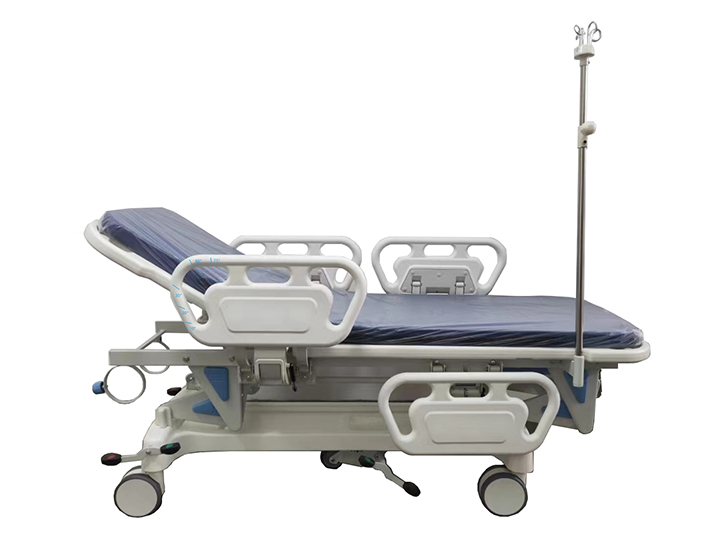
Transfer stretchers are
specialized mobile beds designed for safe, efficient patient transport. The 7 main types - basic hydraulic, advanced hydraulic, ambulance, OR, imaging, bariatric, and foldable - serve distinct clinical scenarios from ward-to-ward transport to trauma imaging.
When choosing a transfer stretcher, match the type to your primary use case, verify dimensions against your facility's elevators and corridors, and confirm load capacity matches your patient population. Imaging compatibility is worth the premium for ER and ICU workflows.
ICARE manufactures all 7 types under ISO 13485, with the CA series covering basic transport (USD 1,200) to imaging flagships (USD 4,000). Browse the complete transfer stretcher lineup or compare models in detail.
