How do we solve the problem of air crossflow in all-steel fume hoods?
all-steel fume hoods are still widely used, and you can see them in many places. However, there will always be some problems during its use, among which the air leakage problem is a relatively common problem. So, how to solve its cross-wind problem?
All steel fume hoodThe safety performance of equipment is an attribute that needs to be guaranteed, because if a safety accident occurs in equipment originally used in the safety field, the damage to experiments and scientific researchers will be unimaginable. In many unexpected situations, the laboratory is damaged or personnel are injured due to equipment failure or temporary breakdown. Therefore, its safety performance is a design element that needs to be considered.

All-steel fume hoods have the possibility of airflow. Only by making good use of the air volume adjustment valve can the airflow be prevented. Equipment is also divided into three categories according to the air inlet method. The indoor air is circulated in the cabinet and then discharged to the outside, which is called full exhaust type. This is a widely used type. When the equipment is installed in a room with heating or temperature and humidity control requirements, in order to save heating and air-conditioning energy consumption, the method of taking supply air from the outside, circulating it in the cabinet and then exhausting it outside is called supplementary air equipment.
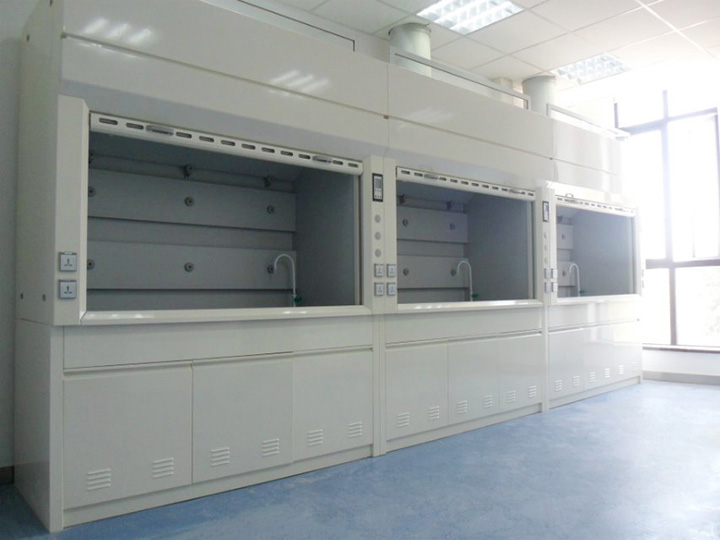
Another type of equipment is variable air volume control. Ordinary constant air volume systems require manual adjustment of the fixed blade air valve to adjust the exhaust volume of the fume hood. When the valve is adjusted to a certain angle, the desired face wind speed is achieved. Variable air volume control is to change the air volume to a given surface wind speed by adjusting the sensor of the valve. Of course, the standard type has low cost, while the variable air volume cost is high, so it is suitable for occasions that require high precision.
